Journal
AI Is Moving From Model Hype to Real-World Systems
Oct 15, 2026 · Donoghteh
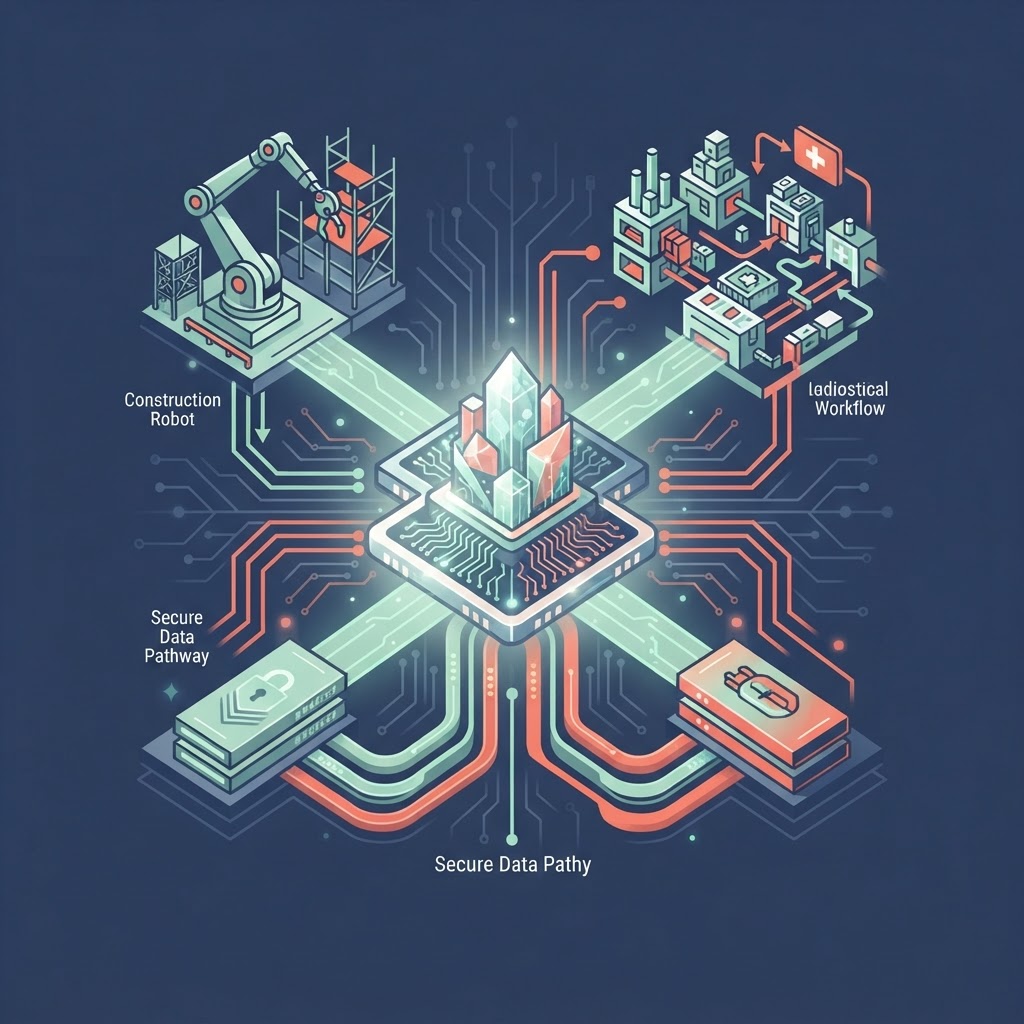
Recent funding in AI chips, security, and robotics points to a market shifting from model capability toward reliable deployment, measurable outcomes, and infrastructure that works beyond the demo.
The next AI race is about what happens after the model works
The AI investment story is changing. For the past few years, much of the market’s attention centered on model scale: bigger systems, stronger benchmarks, and more capable assistants. The newer question is more operational: can these systems work reliably inside the environments where businesses make, move, protect, and deliver things?
Recent funding announcements offer a useful snapshot. On October 13, 2026, construction robotics company ICON announced a $200 million Series D to expand manufacturing and deployment of its robotic construction systems. The same day, AI chip developer SUNMMIO announced fresh financing for its inference-focused processors, while noting that its cumulative funding over the past year approached RMB 2 billion. The exact amount attributable to its latest rounds was not disclosed. These are different markets, but both depend on translating ambitious engineering into repeatable performance outside a lab.
The pattern is not limited to hardware. Pluto Security is building around risks created by employee-built AI applications, while Readily applies AI to healthcare organizations’ regulatory work. Their focus reflects a growing reality: as AI becomes easier to use, organizations need systems that make it safe and manageable to use.
Capability is only the first proof point
A model can produce impressive outputs and still fail as a product. In a real deployment, the system has to fit existing workflows, connect to relevant data, respect permissions, handle exceptions, and provide a clear path to human review. Reliability is not a single benchmark score. It is the accumulated experience of a system doing useful work under varied conditions.
That distinction matters especially in physical industries. Construction systems must meet building standards and perform consistently across sites. Inference chips must deliver competitive cost and performance in production, not just attractive specifications. Robotics must navigate unpredictable environments and complete tasks without creating more work for the people they are meant to help.
For AI software, similar questions apply. Security teams need visibility into what applications and agents can access. Healthcare organizations need tools that fit regulatory processes and support staff rather than burying them in alerts. In every case, integration and operational trust are part of the product itself.
The investment signal: specialized systems, not just general intelligence
The current wave of investment points toward specialization. Instead of treating AI as a standalone feature, companies are building purpose-specific systems around a high-value job: generating a building component, running model inference more efficiently, identifying application risk, or helping an organization meet compliance obligations.
Specialization can create a clearer path to customer value. A buyer can evaluate a defined workflow, compare outcomes with the current process, and decide whether the system is worth adopting. But focus does not remove execution risk. Hardware businesses must solve manufacturing, supply, and deployment. Software companies must earn access to data, fit into day-to-day operations, and show that their outputs are dependable.
Funding is a signal of investor conviction, not proof of durable demand. Announced capital can help a company build and scale, but it does not establish product-market fit, repeat usage, margins, or customer retention. Those questions require evidence from deployments over time.
What founders should measure
For founders, the practical lesson is to define the job before claiming the transformation. Measure the time and cost of the workflow today, then track what changes after deployment. Useful indicators may include completed tasks, error and rework rates, escalation frequency, time to resolution, cost per accepted outcome, and repeat usage.
The right metric depends on the product. A chip company may need to show performance per watt and total cost under real customer workloads. A security product may need to demonstrate that it surfaces meaningful risk without overwhelming teams with false alarms. A robotics company must prove that machines deliver consistent results under the constraints of real sites.
Founders should also be clear about uncertainty. Where does the system act autonomously? What requires human approval? How are failures detected and corrected? A product that makes these boundaries visible can be easier to evaluate and safer to adopt.
What investors should look for beyond the announcement
For investors, the diligence question is increasingly whether technical differentiation survives contact with operations. Look for reference customers, repeated deployments, expansion within accounts, measurable improvements, and transparent evidence about performance. In infrastructure businesses, examine manufacturing readiness, supply dependencies, and the economics of serving real workloads. In applied AI, look for workflow ownership, data access, integration depth, and a credible plan for handling failure.
The most important distinction is between a capability demonstration and a reliable system. Demos show what might be possible. Durable businesses show what customers can depend on, repeatedly, at a cost that makes sense.
The next phase rewards execution
AI is moving into more consequential settings, from physical construction to enterprise security and healthcare operations. That expansion creates opportunity, but it also raises the bar. Buyers do not need capability in the abstract. They need systems that deliver useful results, fit the way work gets done, and behave predictably when conditions are imperfect.
The strongest companies in this phase may not be those making the loudest claims about intelligence. They may be the ones that turn specialized technology into dependable infrastructure, prove its value in real workflows, and earn the right to be used again.
Sources
- [Tech Startups: Funding announcements for October 14, 2026](https://techstartups.com/2026/10/14/startup-funding-news-today-october-14-2026-allara-icon-pluto-security-souffle-therapeutics-sunmmio-more)
- [TechCrunch: Arena raises $200 million at a reported $3.1 billion valuation](https://techcrunch.com/2026/10/08/popular-ai-leaderboard-arena-nearly-doubles-valuation-to-3-1b-valuation-in-10-months/)
- [TechCrunch: Manus raises more than $500 million](https://techcrunch.com/2026/10/08/chinas-manus-raises-over-500m-in-first-funding-round-since-split-with-meta/)