Journal
AI’s Next Infrastructure Bet: Agents, Security, and Personal Compute
Oct 8, 2026 · Donoghteh
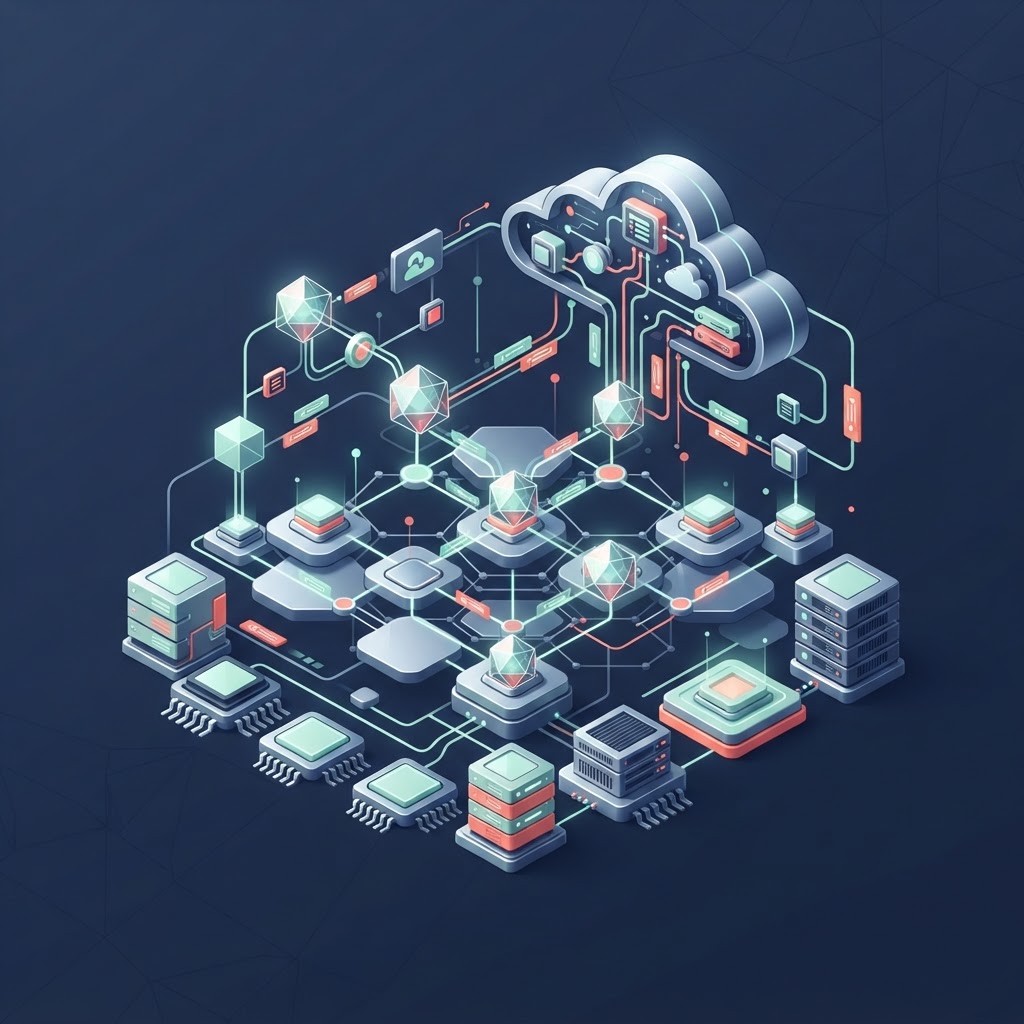
Recent funding rounds point to a broader AI investment thesis: not just better models, but the infrastructure that lets agents act securely across enterprise and personal workflows.
The latest AI funding stories are beginning to describe a market that is larger than the model race. Capital is flowing toward systems that make autonomous software usable: compute designed for agents, persistent security testing, and hardware that can run personal AI locally.
That shift matters because a capable model is only one part of an operating system for intelligent work. To move from demonstrations into repeated use, AI products need reliable execution environments, access to relevant context, clear permissions, and ways to detect failure before it causes harm.
Security becomes continuous
On October 1, TechCrunch reported that Armadin raised $255.5 million in a Series B led by Andreessen Horowitz and Accel, at a valuation above $2.5 billion. The company describes its approach as always-on, agentic security testing: software agents chain vulnerabilities to test defenses continuously, rather than relying only on periodic penetration tests. The raise followed a $190 million Series A in March, according to the report.
The financing is a signal of investor interest, not proof that the product has solved enterprise security. Still, the underlying need is clear. As organizations give software agents more ability to browse, execute code, and interact with internal systems, the attack surface changes. Security tools must test not only individual vulnerabilities, but also how a sequence of actions can be combined.
This creates an important product challenge: security agents need to be effective without becoming a risk of their own. Buyers will want scoped permissions, explainable findings, audit trails, human review for consequential actions, and evidence that remediation reduces exposure.
Personal AI pulls compute closer
A different bet is emerging at the edge. TechCrunch reported on October 5 that Ghost came out of stealth with an $11 million seed round led by Andreessen Horowitz. Its first product, Core, is a $3,499 personal computer built to run AI agents, with a local GPU and software designed around persistent tasks and personal context. The company says personal information and models run locally; these are company claims that customers will ultimately assess through product behavior and independent scrutiny.
The pitch is notable because it treats personal AI as an always-available system, rather than a chatbot opened for one prompt at a time. Local compute may appeal to users who value control over their data, but it also raises practical questions: setup, updates, reliability, electricity and hardware costs, and whether the agent is useful enough to justify a dedicated device.
What the funding signals, and what it does not
Together, these examples suggest that the AI stack is widening. Investors are backing infrastructure around agents: security systems that can reason across attack paths and compute environments designed for ongoing, context-rich tasks. The opportunity is real, but funding announcements should not be confused with evidence of durable adoption.
For founders, the test is operational. Can the product complete a workflow repeatedly? Can customers constrain what it is allowed to do? Does the system recover gracefully when it is uncertain? Is its cost predictable at the level of a completed task, not merely a model call?
For buyers, pilots should measure time saved alongside error rates, escalation frequency, permission boundaries, and the effort required to maintain the system. For investors, the most useful diligence may focus on retention, expansion, security posture, and the gap between impressive demonstrations and dependable production use.
The next layer of competition
The model layer will continue to advance, but competition increasingly depends on the surrounding system. Trustworthy permissions, private context, secure execution, and useful integrations can turn raw model capability into a product people rely on.
The next generation of AI infrastructure will be judged less by how autonomously it can act in a demo and more by how safely and predictably it can act in the real world. That is where the agent opportunity becomes an operating business.